

In a future battlespace, boats, vehicles and weapons could deploy and travel with outer shells or coverings that change with the terrain — or even light and time of year — to add an extra layer of concealment.
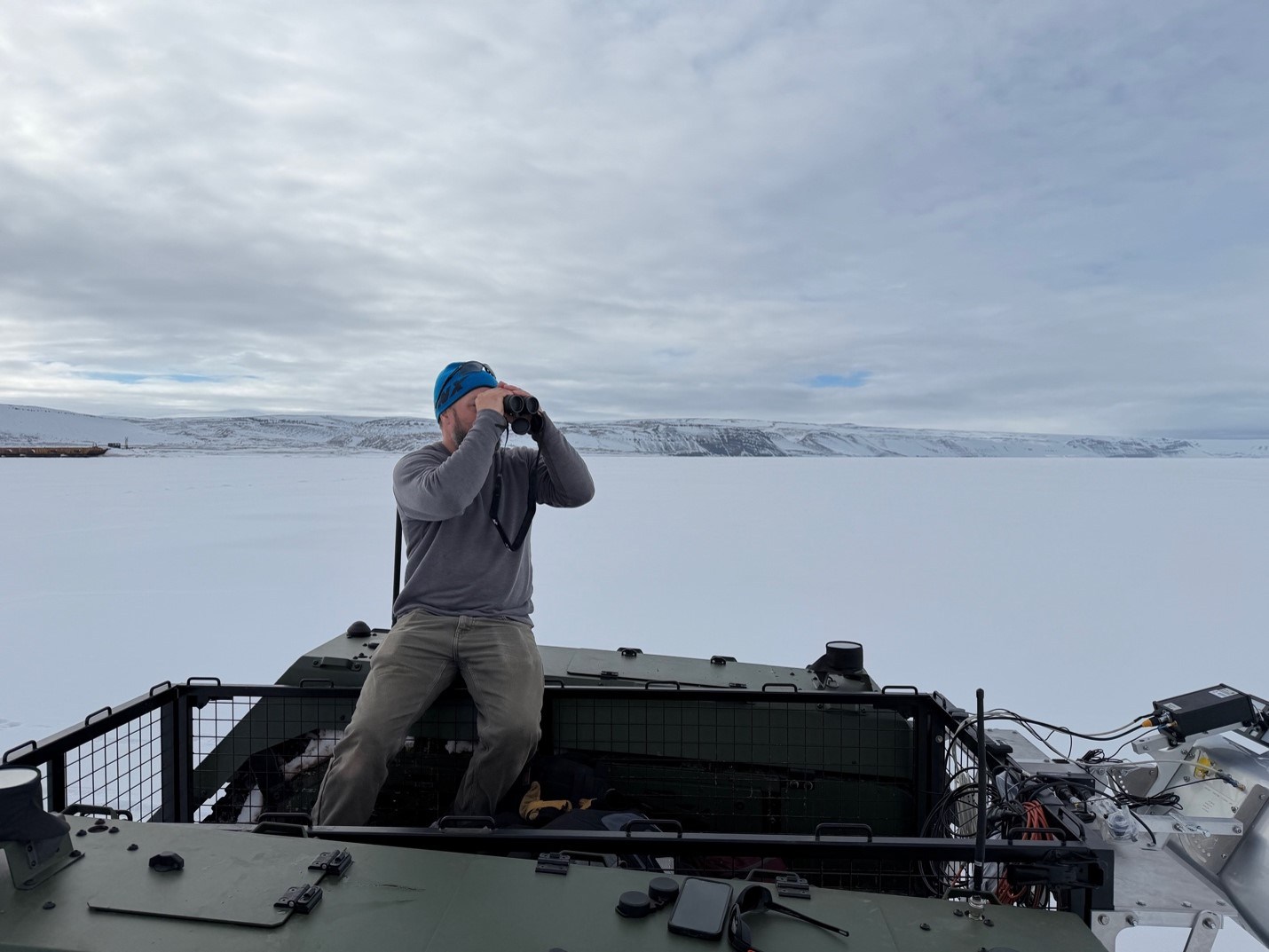
That concept was one of the key testing lines of effort in an Army Corps of Engineers and Army Research Laboratory experiment in Pituffik, Greenland, earlier this year. The whole endeavor was part of a broader testing series organized by the International Cooperative Engagement Program for Polar Research (ICE-PPR) and the Office of Naval Research, a multi-national endeavor that underscores the ever-increasing importance of the Arctic as a warfighting domain.
It is also a domain that presents unique challenges for camouflage, said Dr. Tom Douglas, a research chemist and senior scientific technical manager of the Army Corps of Engineers’ Cold Regions Research and Engineering Laboratory Alaska Research Office in Fairbanks, Alaska.
“It’s dark for some periods; it’s light for other periods,” Douglas told Military Times in an interview. “Everything can look kind of yellow or orange when the sun’s setting … you’ve got sea ice, which can look kind of gray … You can stand out pretty blatantly in a vast open white field where there’s no vegetation, right? So there’s that, and then thinking about coatings or snow covering things, and maybe making it worse now that your camo doesn’t work.”
Anthony Fragoso, a cold regions artificial intelligence lead at CRREL, said that his lab worked with ARL staff during ship-to-shore operations to test “a number of novel coatings,” using sensors to assess the effectiveness of concealment.
“If you go beyond the visible, which our adversaries can do, snow in certain wavelengths looks black. But it’s white in visible,” Fragoso told Military Times in a separate interview. “So trying to match that is a challenge.”
Researchers, Fragoso said, were inspired by Arctic foxes in Pituffik, which change colors over the course of the year – from white in the winter to brown in the summer.
“Things that are reversible, flexible is kind of what we’re after,” he said, adding that researchers considered units like the Alaska-based 11th Airborne Division, which also regularly deploys to the Pacific.
“They’re the Arctic Angels, but they are also worried about fighting in the jungle,” he said. “So they don’t want to paint stuff white, and then it has to go to Taiwan.”
While still at the scientific research and development level, the work is making its way to operational units already, with upcoming plans to test a rapidly deployable coating system on the Army’s Cold Weather All-Terrain Vehicles in Alaska.
“The Alaska National Guard is going to fly over it with helicopters, film it with thermal, all that stuff,” Fragoso said. “Everything now is counter-[unmanned aerial systems], so it’s making sure stuff isn’t being spotted from above by a $1,000 drone.”
Mike Parker, the cold regions mobility lead for CRREL, emphasized that this effort to test flexible camouflage extends beyond the Arctic.
With surveillance from above essentially a given in contemporary warfare, additional layers of concealment, particularly those that can be easily altered to fit changing environments, are in unprecedented demand.
“It has to remain flexible, and all aspects of it are on the table,” Parker said. “It doesn’t have to be just a coating; it could be a fabric … anything that can give us the tactical advantage is being evaluated.”
Read the full article here