

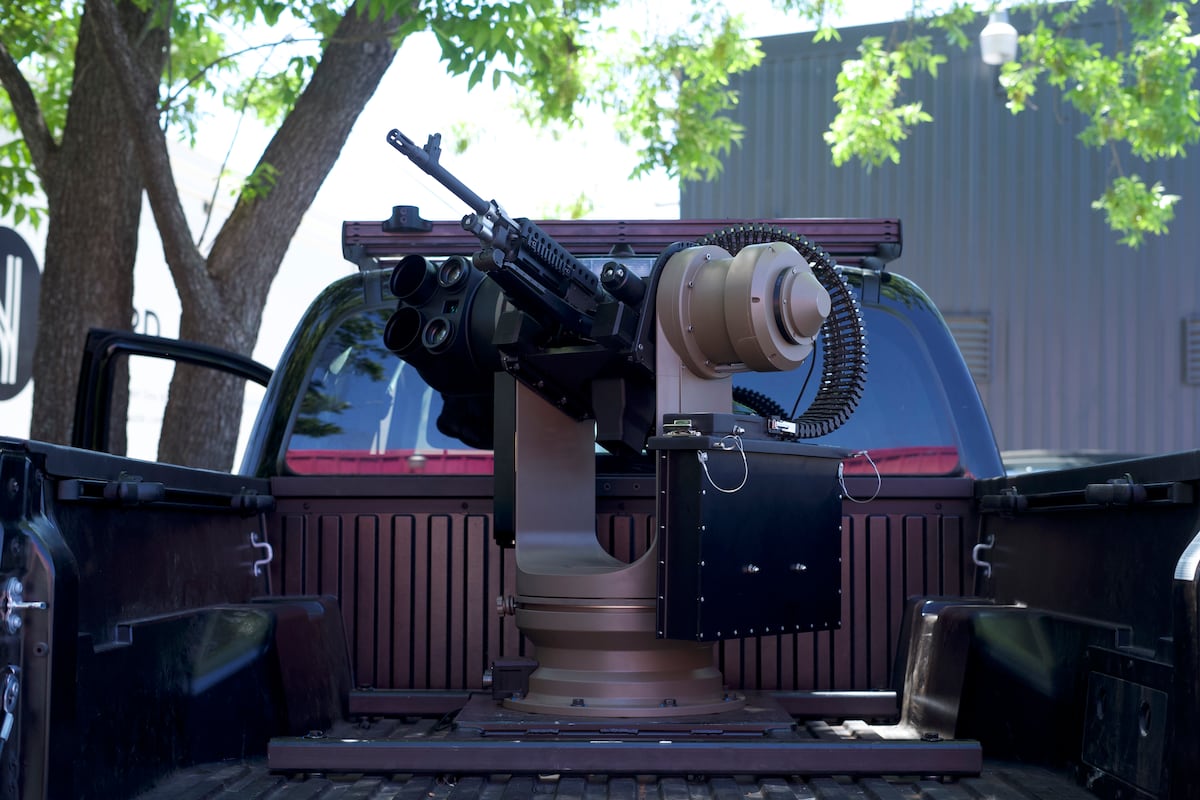
LONDON — The weapon’s barrel points towards a drone in the sky. It briefly adjusts and then fires, with smoke rising where the round shoots.
But instead of a service member resting a finger on the trigger well in preparation for the next shot, in video footage of the Bullfrog weapons system, a hulking, metal machine tilts the weapon just slightly, refocusing itself.
As the U.S. contends with steep expenses to counter cheap drones, Allen Control Systems, or ACS, announced Monday that the Marine Corps has chosen the Bullfrog autonomous weapon system to integrate into its airborne defenses.
The futuristic apparatus is an AI-enabled weapon system that detects, tracks and then automatically aims firearms against aerial threats like drones. That Marine Corps selected the system under its Ground Based Air Defense, or GBAD, program, which develops and fields capabilities to protect forces from airborne attacks.
The service plans to incorporate the Bullfrog into its Light Marine Air Defense Integrated System (L-MADIS), a counter-unmanned aircraft system mounted on two vehicles that relies heavily on electronic warfare.
The system is already in use in the Army and Navy and has been approved by Joint Interagency Task Force 401, the Pentagon’s unit established to streamline the acquisition of counter-drone technology.
The Defense Department’s focus on countering drones comes as conflicts in Ukraine and the Middle East have underscored the increasingly important role of cheap drones on the modern battlefield. The Pentagon has placed a growing emphasis on developing and fielding counter-drone technology that is more scalable and less pricey.
Their prevalence has exposed the economic imbalance of U.S. air defense, as small, relatively inexpensive drones have forced the country to expend expensive interceptor missiles that can cost millions of dollars to make.
The challenge has become especially pronounced during the U.S. war with Iran, where American forces have relied heavily on costly defenses to counter Iran’s Shahed drones, which can cost around $35,000 compared to around $4 million for some interceptors. Experts have warned that the cost of a prolonged war may drastically deplete U.S. interceptor stores.
An ACS press release on the Marine Corps deal linked to the Bullfrog M240, which is compatible with the U.S. military’s belt-fed, fully automatic M240 machine gun. According to the company, the M240 system has a maximum effective range of nearly half a mile and can attack medium and large drones weighing up to 1,320 pounds. Without ammunition, the system weighs 300 pounds.
According to the company, which also has variants that support the M2 machine gun and M320 chain gun, the M240 system has “a cost-per-kill as low as $10.”
Other defense firms are also working to procure more affordable counter-UAS defenses. This week, Lockheed Martin announced a cheaper Patriot interceptor missile that they say will have a price tag of less than half of what other multimillion-dollar interceptors cost.
Eve Sampson is a reporter and former Army officer. She has covered conflict across the world, writing for The New York Times, The Washington Post and The Associated Press.
Read the full article here