

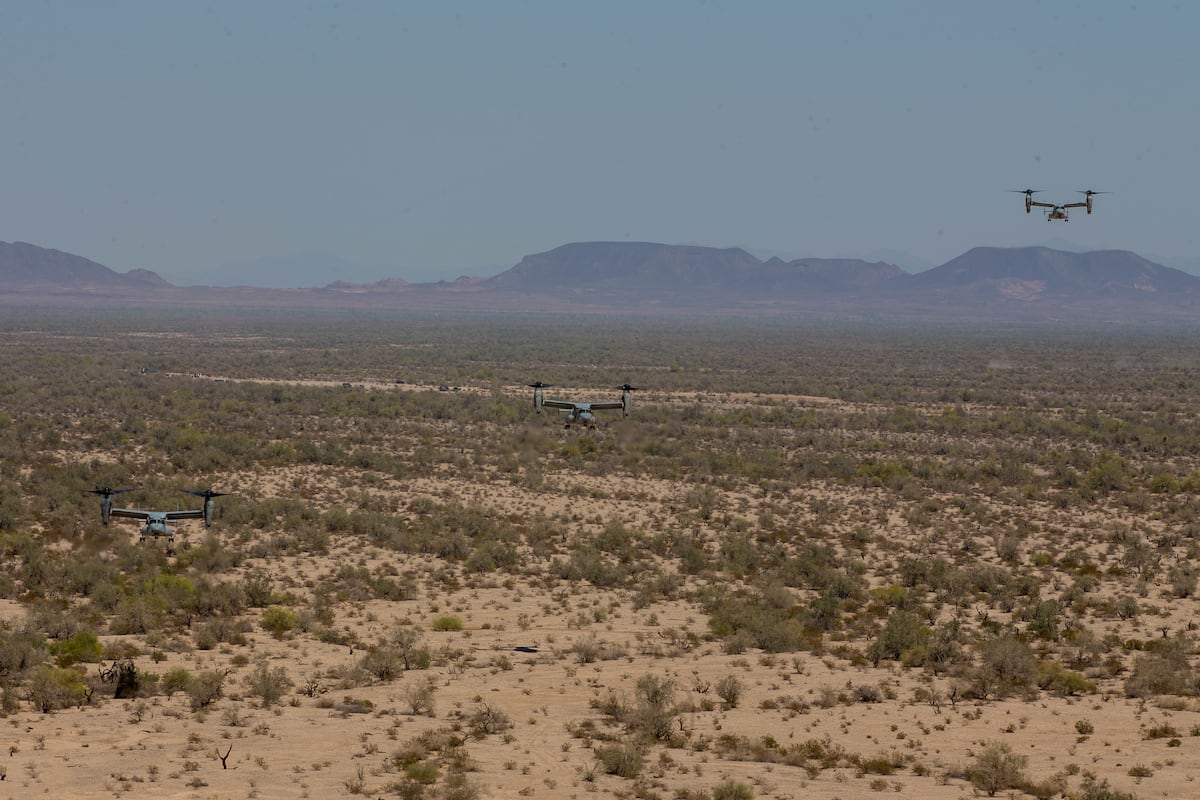
A Marine Corps MV-22B Osprey tiltrotor aircraft caught fire Sunday while on the ground at an airport in Mesa, Arizona, for a joint exercise.
The aircraft, from Marine Medium Tiltrotor Squadron-266 based at Marine Corps Air Station New River, North Carolina, suffered a fire in its right nacelle — the covering for the right engine and its components — Marine Corps officials said.
The pilot and air crew conducted an emergency shutdown and safely evacuated without injury, according to the service.
A video posted on Instagram by an Arizona local pilot showed the aircraft’s right engine housing engulfed in flames and firefighters using foam retardant to quash the fire.
The aircraft was in Arizona supporting Exercise Savage Jackal, an Air Force-led training exercise based at Davis-Monthan Air Force Base in Tucson, according to Maj. Joe Leitner, the 2nd Aircraft Wing’s director of communication strategy and operations.
Leitner said an investigation into the mishap is underway. He did not provide an estimate of the damage or projected cost of repairs.
The Bell Boeing Osprey aircraft, which takes off and lands like a helicopter but can transition its propellers to fly like an airplane, has a history of issues and mishaps that have resulted in the deaths of 65 service members since 2000.
In 2023, the Defense Department grounded the entire fleet following the crash of an Air Force CV-22B Osprey which was determined to have been caused by the failure of the left-hand prop rotor gear box.
The crash, which killed eight Air Force Special Operations Command members, followed numerous reports of problems and a deadly 2022 mishap caused by a sprag clutch, a component that works to ensure that both rotors spin at the same speed, keeping the aircraft in balance.
Tuesday’s fire at the Mesa Gateway Airport occurred roughly 65 miles from the Marine Corps’ deadliest accident involving an Osprey aircraft. On April 8, 2000, 19 Marines died during a night exercise at Marana Regional Airport near Tucson, seven years before the MV-22 was officially fielded in the Corps.
Investigators concluded that pilot error caused that fatal accident, with the pilots descending at 250% the acceptable rate, creating a “vortex ring state” that resulted in an unrecoverable situation from a rotor stall and loss of lift.
A later investigation cleared the pilots of wrongdoing.
The Defense Department is slated to close its Osprey production line in fiscal 2028, according to the Congressional Research Service. The DoD has purchased 469 Osprey aircraft: 360 for the Marine Corps; 53 for the Navy; and 56 for the Air Force.
Recently, the Marine Corps MV-22s participated in the daylong military flyovers on July 4 in Washington, D.C.
Service officials said the aircraft that caught fire Sunday was not among those taking part in the 250th Independence Day celebrations.
Patricia Kime is a senior writer covering military and veterans health care, medicine and personnel issues.
Read the full article here