

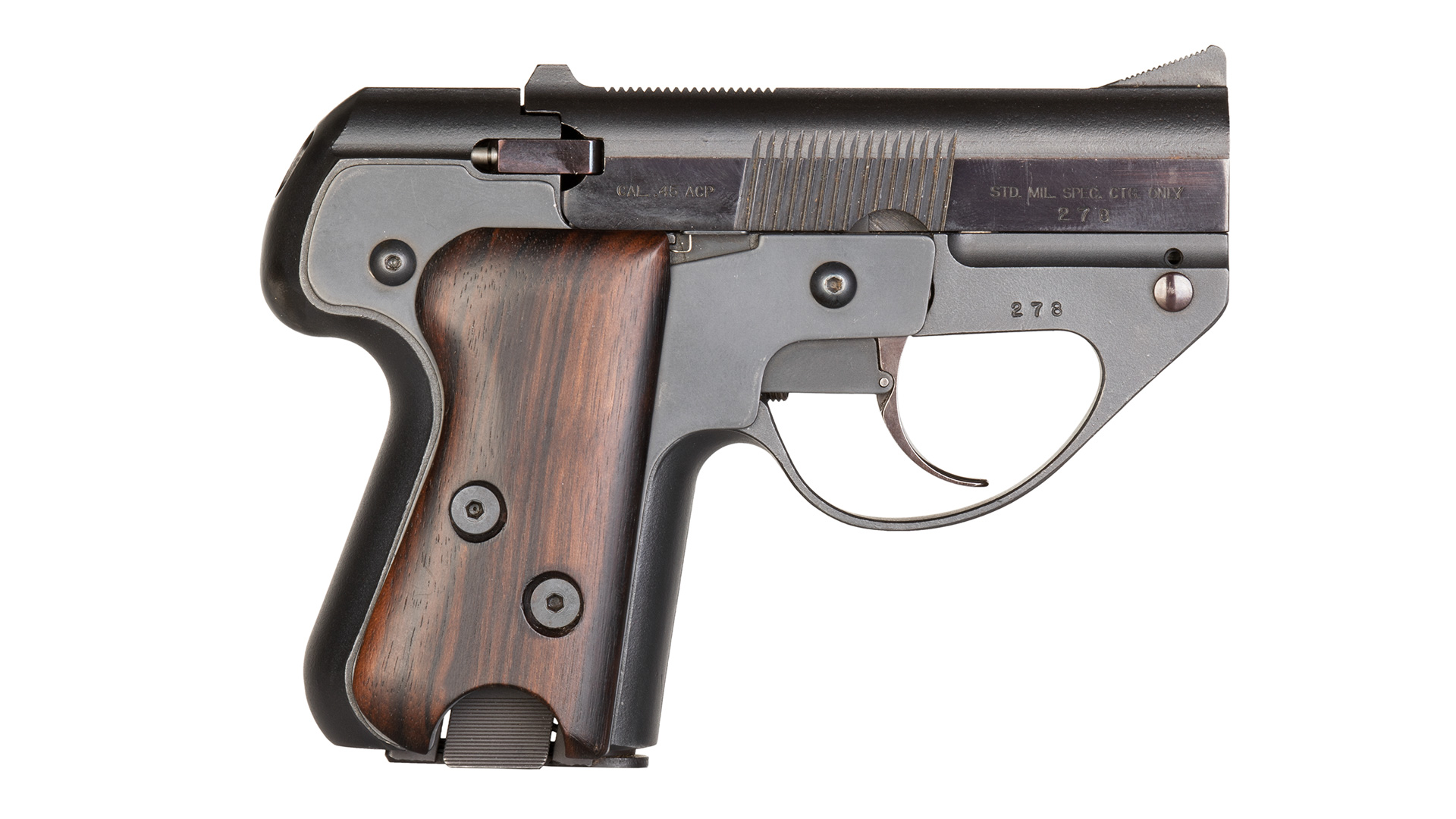
The late 1970s was an interesting era when it came to compact pistols. In the United States, the .45 ACP was king; 9 mm was something best left to Europeans. This was well before NRA helped pass the first Right-To-Carry law in Florida in 1987, and there was limited demand for concealable pistols—but there was some. To combine .45 ACP punch with a very compact pistol, inventor and manufacturer Philip R. Lichtman set up the Semmerling Corporation in Massachusetts.
The Semmerling LM-4 was the smallest .45 ACP handgun available to date. It was not a semi-automatic, but rather a manually operated pistol. This obviated the need for a slide to be cycled as well as a recoil spring—meaning less real estate was required.
Here’s how it works: The frame’s breech contains the fire-control and firing-pin assemblies, with the frame-mounted extractor being stationary. The barrel and chamber slide forward on rails cut into the frame, exposing the action port above the magazine. Pulling the barrel rearward strips a cartridge presented from the magazine into the chamber.
The Semmerling LM-4 received a three-quarter-page review in The American Rifleman in October 1978, before Lichtman’s patent—although applied for—was granted. The gun, serial number 126, was remarkably small. Its overall length was 5.31 inches, and its barrel length was 3.66 inches with a six-groove, right-hand twist.
Inside, squeezing the double-action-only trigger does two things: First, it rotates a tumbler that locks the barrel to the frame, and then its continued travel releases the firing pin to strike the primer of the chambered cartridge. Fully releasing the trigger unlocks the barrel assembly, allowing it to be pushed forward. As it moves, the expended case is held by the extractor until a projection on the left side of the barrel serving as the ejector kicks out the cartridge. The slide is then manually pulled rearward, stripping another round from the magazine. Until the trigger is actuated, the barrel is free to slide forward. When tested in 1978, there were two failures to feed with the muzzle elevated, but none when it was held horizontally, out of 200 rounds. NRA staffers could fire one round per second with this little straight-pull contraption. They wrote “Felt recoil was heavy.” That was a gunwriter code phrase for “extremely unpleasant.”
If you wanted to carry it with a round in the chamber, there was a barrel lock on the right side that if pushed upward, prevented the barrel and cartridge from sliding. But, to fire the gun in that condition, you had to slightly pull the trigger back to allow the lock to drop out of engagement, then you could fire the gun with a full trigger pull. Don’t try that at home.
At the top-right corner of the right-side stock is a small lever that needs to be engaged to carry the LM-4 with a round in the chamber • A beefy extractor makes sure empty cases are cleared during the manual ejection process • Holding four rounds of .45 ACP, the magazine gave the LM-4 the same total capacity as most small-frame revolvers • Unique in its manual operation, the barrel is slid forward by hand to remove the spent case, then pulled rearward to chamber the next round.
Field-stripping was moderately straightforward. Remove the barrel limit pin on the front of the frame, depress its detent, then slide the barrel off the frame. Even though the somewhat quirky manual gives detailed instructions on how to disassemble the LM-4 completely, it also cautioned “the strong striker-torsion spring may tend to pop out, flinging small parts around … . ”
Written right on the gun was an admonition to only use 230-grain, hardball ammunition. Apparently, you could shoot other loads, but it was designed to run with FMJs. The manual included some choice words that, perhaps, predicted the gun’s future: “Do not practice excessively with the LM-4 … Don’t risk breakage by over practicing.”
The Semmerling was heavy for its size, weighing in at 26.5 ounces unloaded; the thing was made of tool steel, after all. Here’s how Semmerling described its construction, circa 1981: “Every action is painstakingly hand fitted. Each gun is exhaustively tested. In fact, no gun is shipped until our president is personally satisfied with it. Maybe that’s why in four years we’ve been making LM-4s, not one has been returned.”
Not enough for you? “Every spring in the LM-4 is stress relieved. Every critical part is individually Rockwell tested. Every single frame and barrel is x-rayed and Magnafluxed multiple times. The result: a remarkably strong, trouble-free weapon that you can stake your life on.”
As much time and attention as went into essentially hand-making each one of these guns, they were predictably expensive. Suggested retail on the version tested in 1978 was $645. You could accessorize your LM-4 with cocobolo stocks, hard-chrome plating, extra magazines, spare parts, a holster and a magazine pouch. All of those things were for extra cost, of course. Realize a Smith & Wesson Model 29 .44 Mag. revolver in 1980 only cost $319.50—that’s right, the Semmerling cost twice as much as Dirty Harry’s revolver.
The “Blue Book of Gun Values” indicates the guns were made from 1977 until 1982 by Semmerling, and it is thought that it made somewhat less than 600 pistols. The LM-4 and other models were later made by the American Derringer Corp.
The world’s largest organic deposit of Semmerling pistols can be found at NRA’s National Firearms Museum. There are 22 of them on display, including just about every finish and variation, in a case entitled, rightly, “Weird and Wonderful.”
They got it half right.
Read the full article here